Sunday, March 5, 2017

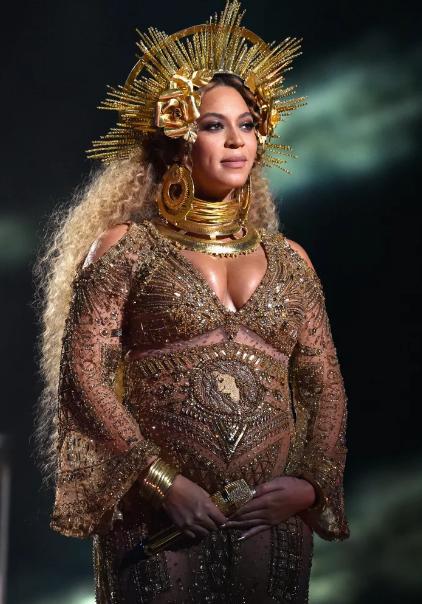
TOW #21 - visual: Beyonce's Grammy Dress

The Grammy’s are always a big deal in America. Who looked the best, who looked the worse, what went wrong and what went right. Everything is analyzed, critiqued and ridiculed. This year, the Grammy’s occurred around the time BeyoncĂ© revealed to the public that she was pregnant with not just one, but two babies. The dress she wore during her performance showed symbolism and put the crowd full of a-list celebrities in awe.
            Beyonce’s dress seemed to show the public her excitement for motherhood and her love and care for her unborn children. The dress featured intricate beading, but all eyes were on the center of the dress, where her pregnant stomach appeared. The dress had a beaded woman over her baby bump, appearing to be happily looking down. This shows the nurturing of her children, the love she has for them, and how blessed she feels.
            By utilizing symbolism, Beyonce is showing the world her view on motherhood and her excited for the future with her twins. The beaded woman on her dress shows a symbol of herself and her happiness. A lot of the public did not know she was pregnant before the Grammy’s, this performance and this dress being her debut of the news. The symbolism effectively shows how she feels about the news of her two children.
            Her purpose is to show her feelings of the news of her two children and inform the public on how she will truly care for these children. The beading on her dress representing her shows that she is looking down on them and caring for them, preparing for their journeys on Earth.

Friday, February 24, 2017

TOW #20 - article: "President Trump Breaks a Promise on Transgender Rights"

            In the article “President Trump Breaks a Promise on Transgender Rights” by the Editorial Board of the New York Times, the recent decision of Donald Trump is criticized and put under a negative light. His new decision to leave it up to the states to decide transgender rights is causing a lot of controversy and is upsetting a lot of people. The author feels as if this is a step in the wrong direction to all the achievement America has made with LGBTQ rights.
            The audience is the general educated public. The author clearly has an urgent tone and wants the audience to know that they believe the decision to give the power to the states is not a good one and many people could soon begin to lose their rights. The author also discusses the lying mechanism of Trump and how he said he would protect LGBT rights and is now making a hypocritical decision. At the end of the article, it is said that it is now up to us, the people, to make a positive change in this movement and keep everyone in America safe and under fair and equal rule.
            I agree with the author’s viewpoints. I am also in agreement that Trump is not standing by the words he spoke during his campaign and he is being hypocritical. I also think that it is very important for everyone to have equal rights and for everyone to be protected under the law. This new law singles different people out and erases the progress that was made before. I think no one should have to live in fear when in reality we are all equals and all deserve the same rights.

            The purpose of the article was to show the general educated public that Trump has changed his view points and that there are many controversial arguments taking place. I think the article could have been stronger if the author included more detail about what the law change is and how it works.

Monday, February 20, 2017

TOW #19: article - "Is Junk Food Really Cheaper?"

          Would you rather drive a minute and get a high-calorie low-nutrition hamburger from the nearest fast-food restaurant or drive fifteen minutes to a grocery store and buy ingredients to make a healthy meal? This question in the game of would you rather is one that many Americans are struggling to answer. In the New York Times article “Is Junk Food Really Cheaper?”, Mark Bittman discusses how the idea that fast-food is cheaper than a home-cooked meal is false.
            As an attempt to reach the general public of America, Bittman shows his interest in trying to change the perspective of America and showing them that fast-food is more expensive, unhealthy and is manipulating the culture of people living in this country. Bittman states that a meal for a family of four at McDonalds is much pricier than buying ingredients to a healthy meal. The author gets deeper into the problem of fast food: laziness and convenience.
            Bittman uses data and compare and contrast to get his point across to his audience. Data presented shows various things such as how inflation increased the price of fresh produce and decreased the price of soda to the cost of fast food meals versus healthy meals. This data proves to the audience that the real problem lies within each American. Fast food is changing the neurological wiring in Americans, making them have an addictive reaction to the food. The only way to change the habit is to change the American environment. Bittman also compares prices and nutrition to make a statement about how drastic the difference of eating can be.

            The author wrote this with the intention to show Americans that their preconceived ideas about the cost of fast food are wrong. Bittman wants to give his audience a call to action and tell them to make a change and spread the truth about fast food. 

Sunday, February 12, 2017

TOW #18: visual: Women's Rights

         In the rising controversy against the opinions of president elect Donald Trump, women’s rights is one that majorly stands out. Only a short bit ago, millions of women across the nation got together in their cities to march for the rights they deserve. Using peaceful protests to get the attention of the problem at hand, women marched together. It is a fact that men on average get paid more than women, even sometimes for the same exact job. This political cartoon depicts the cutout of a man as an entrance to good careers, implying that women are not cut out for good careers and although employers claim that they give equal opportunities, they do not.
            This visual, attempting to reach the general public of America, is trying to get the message across that women indeed are not equal. The visual even goes to the extent to say that many employers are lying to the public by saying the give equal opportunity when they do not. Amidst the rising tension between Trump and the women of America, this visual has quite an occasion.
            The author utilizes contrast in their political cartoon. The contrast of the women’s shape to the shape of the man shows that there is a really big problem in the difference between the opportunity men and women get. The contrast effectively shows women being less than men.

            The author’s purpose is to show what is happening and open the public’s eyes to what is happening. The author wants to visually show the disadvantage women are always at. Ultimately, the author is urging the public to take action and defend women and get them the rights they deserve. This was effective, considering the amount of recent attention to women’s rights.

Monday, February 6, 2017

IRB Intro Post #3

     For the third marking period, I am choosing to read the book The Social Animal by Elliot Aronson. This book is gives a perspective on social psychology and why people behave the way they do. The author, Elliot Aronson, presents the research and ideas through real life scenarios and various studies. Human nature and social psychology is depicted through patterns in behavior. The book also connects subjects such as politics, religion, race, obedience, terrorism and more to the aspects of why we act the way we do. This book is a guide through social psychology and leads the reader through a journey of figuring out why we do what we do. I chose to read this book because I have a very strong interest in psychology and want to pursue it in the future. I am hoping to gain answers in my questions about myself and human nature in general.

Sunday, February 5, 2017

TOW #17 - article: "The Argument Against Headphones"

         In the article “The Argument Against Headphones” by Virginia Heffernan, statistics and history of headphones is discussed in the means to inform and argue that the cons of headphones outweigh the pros. Heffernan, an author for The New York Times, begins her article with data. Teenagers in America are beginning to have hearing loss at an earlier age. Although, given the rise in technological devices with headphone inputs, this hearing loss in the current teenage generation will continue to prosper.
            This audience is mainly geared towards parents of teenagers who use headphones often. The last sentence of the article reads, “And protecting our kids’ hearing is not just as important as protecting their brains; it is protecting their brains” (Heffernan). Parents have a big say in what their kids and cannot do and are involved in maintaining their wellbeing. If parents know how serious the consequences could be by allowing their children to stimulate their ears with such high volumes, they may try and have them cut down on headphone usage.
            I agree with the author’s central claim. I think that her argument against headphones is valid and many teenagers are heading down the path towards early hearing loss, which can be stopped if more information were known about the subject. This leads to the purpose of the article, to argue against headphone usage and encourage a movement to stop excessive usage. Today, wireless headphones are becoming a very popular possession. I think the author would not like this new rise of headphone technology. It makes headphones all the more appealing and makes a wider audience of people vulnerable to the damage headphones can do.

            The purpose of the article was successfully achieved and the consequences of headphone usage were clearly laid out, creating an effective argument. I believe the argument of the article could have been stronger if there was less of a focus on the history.

Friday, December 16, 2016

TOW #13 - IRB: The Glass Castle

The Glass Caste, by Jeannette Walls, has a very unique introduction and start to the novel. In a needy family, Walls often travels around the country just to find herself moving away again. There is really no point in which she officially settles somewhere. Walls’ parents, people very seemingly unfit for the parental job, locate to the desert for the beginning of Jeannette’s childhood. She becomes fascinated by nature. After relocating to West Virginia, attempting to leave growing debt and alcoholism, the children realize their need to leave.
            In an attempt to share her unique story, Jeannette Walls illustrates the complications of families in America. Her story, although far outside the norm, is only one of many similar unwritten stories of people whom could not leave their hard lives. Walls expresses a want to free herself from her past, giving the novel an occasion. She wants to run away from the lies and hiding.
            Although the situation Jeannette is in is very troublesome and difficult, she constantly uses humor and diction to appeal to her purpose. Humor is used throughout the book to create an inspirational tone. Even when the worst parts of her childhood were being explained, the humor put a hopeful tone in the book and foreshadowed the fact that Walls was able to escape the constraints of her past. Diction is also used to appeal to the purpose. Diction is used to describe the uniqueness of her childhood. Each time the family relocated, the diction allowed the reader to understand the emotions and the thoughts of the author.

            Jeannette Walls wants to inform her audience about her past in an attempt to teach them that no matter what, it is never too late to liberate yourself from your past. She teaches the audience that keeping struggles and lies inside make for inevitable disaster. I believe she does this in an effective way and allows the audience to learn a lesson from a unique perspective.

Tuesday, December 6, 2016

TOW #12 - article: "You Have No Idea What Really Happened"

When something significant happens in your life, it is usually embedded in your mind for a long period of time. The memory of this event makes the certain day clearer than any other average day. Although, when put to the test, your memory of that day is not as sharp as you would confidently think. In the article “You Have No Idea What Happened” by Maria Konnikova, the way memory works is questioned and explained.
            There are many unsolved conclusions to how memory works. Ulric Neisser, a cognitive psychologist, put his students to the test. A few days after the explosion of the Space Shuttle Challenger, Neisser asked his students to take a short quiz recalling where they were and what they were doing when they heard about the news of the explosion. Two years later, the same student were asked the same questions in hopes of drawing the same conclusions. Although their confidence of the accuracy of their answers were at an all-time-high, their answers were almost all incorrect. In an effort to inform and prove that our memories are not as sharp as we perceive them to be, Konnikova draws in the psychologically interested public to show them their wrong thinking.
            As a majorly informative piece, Konnikova presents her evidence through different research projects and data, such as neuroscientist Lila Davachi’s study using pictures of animals and tools being paired with a series of shocks. This information found that once an emotional event occurred as you saw an image, such as being shocked as you saw an animal, your memory of animals you have previously seen would be enhanced. This informed Konnikovas audience that memory is strengthened at periods of more emotion.

            Although people tend to feel confident when recalling their memories of an important event, our thoughts get jumbled and after time goes by, our recollection displays an incorrect view of what happened. So, Konnikova asks her audience, what really did happen?

Sunday, December 4, 2016

TOW #11 - article: Second Inaugural Address of Abraham Lincoln

           Compared to first, Lincoln’s Second Inaugural Address was shorter and simpler to the first. Since Lincoln had already completed his first term in office during the complete duration of the Civil War, his Second Inaugural Address was about reuniting the United States. Lincoln viewed the war as a something the North and the South should get past and create union and peace.
            This address has a very large and general audience, being that he is targeting both the North and South regions of the United States. As an attempt to open the eyes of the general public of America, Lincoln aimed to teach the United States to “strive on to finish the work we are in, to bind up the nation’s wounds, to care for him who shall have borne the battle and for his widow and his orphan, to do all which may achieve and cherish a just and lasting peace among ourselves and with all nations.”. This address, being during the time of the pending conclusion of the Civil War, was aimed towards reparations rather than mistakes of the past.
            A strong strive for unity can be taken out of this speech. The purpose, being to inform the opposing sides of the North and South about the importance of unity and peace, is supported through repetition and diction. Lincoln mentions God many different times throughout the address. By bringing in a spiritual aspect, Lincoln connects the two sides and provides something both the North and the South can claim. Finding things in common with the opposing forces help bring them together. Lincoln’s diction also plays a role in achieving his purpose. He uses words with positive connotations such as “bind up”, “achieve”, “strengthen” and more. These words make the address seem hopeful.

            As the president, it is one’s duty to unify a nation and but the citizens of America before all else. Lincoln’s purpose in addressing his people was to provide means to unify and to bring two sides together to make peace. I think that his purpose was achieved because Lincoln went straight to the point of his address and kept his thoughts concise and upfront. 

Tuesday, November 15, 2016

TOW #10 - visual: Mural in Philadelphia

           There are many different ways to express opinions. Whether that be art or writing, each unique way gets a message across to an audience. A common way to express these messages in the city of Philadelphia is through the art of murals. Pieces of influential art are found on walls of buildings everywhere. Some artist use these murals to try and make a change, yet some artists only paint for their own satisfaction. This particular painting illustrates the image of a young African American boy standing in the middle of a city with his arms reaching up to create a fully grown tree. The roots of the tree run down his arms, resembling his veins.
            Being that this mural was painted on the side of a large building within the city of Philadelphia, the audience is the general public of the city. The message that this mural promotes is one that the artist wants to get across to a wide range of people. The occasion of the art can be assumed, that for a while African Americans have been oppressed. This painting shows that everyone is equal and everyone has potential to create opportunities for themselves.
            The artist uses various rhetorical devices such as personification and contrast. The roots of the tree are being personified as the veins of the child holding the tree in his hands. This personification promotes the message that anyone can open doors for themselves and that their life has worth. The contrast being utilized is found in the colors of the mural. Surrounding the boy in the center, there is a yellow outlining. This makes a contrast between the boy and the background of the mural. The yellow outline makes the boy stand out and leads your eyes to follow the mural up to the tree, or the message within the mural.
            The purpose, that every child has worth and potential, is very clearly and artistically conveyed. I was immediately able to see what the author wanted to show and take away a very important message.

Friday, November 11, 2016

IRB Intro Post #2

For the second marking period, I am choosing to read the book The Glass Castle by Jeannette Walls. This non-fiction memoir is about Jeannette's unique childhood. Growing up with parents who had very different ideals, Jeannette and her three siblings were raised as nomads who moved from town to town. Sometimes, the family would camp in deserts and mountains. Rex, the father of the family, was an intelligent man but was not usually sober. Rose, the mother, was a creative artist whose priorities were a little unorganized. This book is about Jeannette's journey through her interesting childhood and how she managed to escape her roots. I chose to read this book because I think that there will be many surprised involved in reading it. I think that I will be shocked at the nature of Jeannette's parents. I hope to gain a new perspective on how some people live and what it is like to grow up in such a unique way.

TOW #9 - article: "In these classrooms, fidgeting, moving around and bouncing are encouraged"

The article “In these classrooms, fidgeting, moving around and bouncing are encouraged”, by The Dallas Morning News, talks about the new generation of elementary age kids and their unique energy levels. The article describes how the switch from regular chairs to bouncy balls, wobble chairs, pillows and mats has effected the performance of the children. The author is able to present evidence that is very credible because most of the information provided is from the teachers of the experimental classrooms themselves.
            Within the article, the kid’s behavior is analyzed. Although the article does admit that studies have not yet shown that this specific technique of teaching effects elementary school kid’s behavior, the teachers still offer their perspective on how they think the classroom has changed. Many teachers described seeing a lot of difference in the classroom. Kids began to take out their energy by simply wobbling back and forth on their chair. This was a non-disruptive way to allow the child to get their energy out. This information prompted other teachers to transform their classrooms as well, for the better of their students and each of their performances. The occasion of the text would be the energy of kids of this generation. Because of the amount of growing technology, more and more students are being diagnosed with ADHD. These chairs give disabled students a better chance of learning in a more comfortable setting.
            The author uses rhetorical devices such as exemplification and diction to make her purpose, that this specific transformation of the classroom is more fit for elementary school children, clear. Exemplification is utilized through the use of quotations from teacher whom have transformed their own classrooms. These quotes directly add fuel to the authors purpose. The diction the author uses, such as the words and phrases “helpful”, “successful”, “progressive” and “how students work best”, make the purpose stand out as well.

            I believe the author of this article was very successful in giving their purpose. Personally, I did not know much about this topic. The author thoroughly convinced me that the new transformations of the classroom benefitted students.

Sunday, November 6, 2016

TOW #8 - IRB: "Tuesdays with Morrie"

            Tuesdays with Morrie by Mitch Albom is a novel about the importance of relationships in life. Mitch Albom was a student at Brandeis University that created a blossoming connection with his professor, Morrie Shwartz. After graduation, years passed by and the relationship eventually fell apart and each person’s lives continued to go in their individual directions. During the flipping of channels, Albom had a spontaneous reconnection with his long lost professor and committed to visiting him each Tuesday to discuss how to make Mitch’s life flourish to carve a new, happier path.
            Albom reaches out to an audience of the general public with life challenges in the field of relationships. Albom focuses on the details in the lessons he learned from Shwartz, making the book very oriented around the lessons he learned each Tuesday. This draws in a particular audience who is looking to learn about fixing relationships and mending their path in life. By specifically detailing the lesson portion of the novel, Albom is able to guide the audience through an informational lesson on life while characterizing not only himself but Morrie Shwartz.
            Mitch Albom keeps a constant purpose throughout his book. He writes to express Morrie’s outlook on life and what should be considered important in an individual’s journey. This purpose is achieved by using rhetorical devices such as metaphors and anecdotes. By referring to flashbacks often in the book, Albom helps the audience understand why each life lesson is relevant in each Mitch’s and Morrie’s life. Metaphors are also heavily used to show how even when at the end of the book, when Morrie passed away, his lessons still greatly impacted his life and where it would go. The metaphors helped show the audience what impact Morrie’s wisdom had on his life.

            The purpose is communicated very successfully. By the end of the book, the audience had a really clear understanding on the impact Morrie’s lessons had on Mitch’s life, even after he had passed away.

Wednesday, November 2, 2016

TOW #7 - article: "Bop"

            “Bop” by Langston Hughes is a short essay about the history and significance of bop music. Hughes himself was a large part of many civil rights movements, including being a strong voice in the Harlem Renaissance. This makes him very culturally aware, therefore credible enough to speak about the importance and history of bop music to an audience of diverse people. The narrator is in the casual setting of a stoop of his friend, Simple’s, house. They speak to each other about the meaning and history of bop music. Hughes does not know where the strange sounds come from but Simple explains the history behind it to him. The music and sounds incorporated with bop music come from negroes and the sounds they made when they were brutally attacked by the police.
            Langston Hughes uses diction and the first person to convey his purpose, to educate his audience on the history and importance of bop music. The diction within this short essay is very casual, allowing for the audience to be able to easily understand and relate to what he is saying. Hughes is then able to get his purpose across more easily and meaningfully. The simplicity of the essay adds to the overall effect it has on the audience. The use of first person also allows the audience to deeply connect with the narrator. It allows the audience to put themselves in the narrator’s shoes because neither the audience or the narrator know the meaning behind bop music when the essay begins. Therefore, the audience and the narrator can grow together.

            The author’s purpose, the inform the audience about the meaning behind bop music, is successfully displayed in the essay. It takes the narrator and the audience into a relatable conversation that guides the history of the unique music in a step by step process. This allows the purpose to come off clearly and meaningfully. 

Sunday, October 23, 2016

TOW #6 - visual text: credibility of presidential candidates

The presidential election has fueled the United States into one big argument. It has sparked conversations not only in this country, but across the world, causing controversy wherever it may go. The news is filled to the brink with political articles and conversations in this day always seem to come back to one topic: the 2016 presidential election. The candidates, Hillary Clinton and Donald Trump, are two extremely strong forces with clashing views. The author has an obvious bias and the reader is able to clearly see which side the author has chosen, and that is the democratic side of Hillary Clinton.
            Within the cartoon, Donald Trump’s brain is presented at a size about a third of Clinton’s. This shows the viewpoint of the author, how they believe Trump’s intelligence level is incomparable to Clinton’s. This provokes a certain audience, one with the belief that Trump is the favored candidate. This political cartoon is propaganda and is being used to persuade the audience to change their viewpoint. On the brains of each of the candidates, there are pictures representing where their knowledge comes from and where their credibility resides. Trump has a Twitter logo on his brain and Clinton has a senate seal. The difference between this is obvious; Trump does not have the “brains” to be president because his only referral to being credible is a social media website.
            The author uses rhetorical devices such as comparison and imagery to portray their message. They compare the brain of Clinton to Trump using relative size. This comparison allows the author to clearly and effectively show their standpoint. The imagery used is shown in the candidate’s facial expressions. Trump, who is portrayed in an unattractive manner, is being demeaned in the cartoon whereas Clinton is smiling and is seemingly confident.

            The author’s purpose, to inform and persuade their audience of the lack in Trump’s credibility, is conveyed successfully. The author clearly takes one side of the argument and proves their case.


Sunday, October 16, 2016

TOW #5 - article: "The Lives of a Cell"

            “Perspective is everything”. This common saying is a common theme of the Lewis Thomas’s short essay, “The Lives of a Cell”. The nature of man is analyzed in biological terms, showing how our smaller parts such as the mitochondria and chloroplasts are our everything. Our whole existence revolves around our smaller parts, the smaller units of our anatomy. We could not pursue our dreams and reach our potential without each microscopic piece of ourselves. This comparison is then made to Earth, the oceans, continents, countries and cities make up Earth and the way they are utilized. Earth is compared to a cell, a small unit of life in the midst of the universe.
            The author tries to open the reader’s eyes to a new perspective, one not often looked at. He tries to reach a general audience, one of average, functioning human beings. Lewis Thomas informs the audience of the smaller units of life and how they are compared to the grand scheme of life. The earth, a small planet in the infinite universe, is similar to a cell, an unimaginably tiny unit of life amidst surrounding functions within a human body.
            The message the author is trying to get across is that each small unit of life should not be looked past. Differentiation of cells should be appreciated; our whole lives revolve around the tiny lives of these living things. Lewis Thomas uses figurative language and comparisons to achieve this purpose. Thomas uses metaphors and similes to show how all life on Earth is connected just like all cells connect to make a functioning human. Thomas also uses comparisons to get his point across. His final words describe his realization that the earth can be compared to a cell. A living, thriving unit of life feeding off the resources around it.

            This comparison is successfully made. The author introduces the reader to a new perspective and uses specific rhetorical devices to clearly present his elaborate ideas.

Sunday, October 9, 2016

TOW #4 - IRB: "Tuesdays with Morrie"

Tuesdays with Morrie by Mitch Albom is a book about an individual journey through life. Morrie Shwartz taught an eager Mitch Albom at Brandeis University. Inspired by his outlook on life and his diverse ways of teaching, Albom visited Shwartz during not only his office hours but personal visits. Upon graduation, Albom promised Shwartz he would keep in touch. This promise was one Albom did not keep and he greatly regrets this.
Years later, a far older, wiser and ALS stricken man, Morrie Shwartz is interviewed and put on “Nightline”, a special on ABC. Albom, flipping through channels, sees this interview with his old professor. Overcome by regret for not keeping his promise, Albom is angry with himself for allowing himself to lose touch with one of his greatest influences who is now months away from death. Albom’s feelings were so powerful that he flew to Boston, Morrie’s hometown, and paid him a visit. These visits became regular and each Tuesday, Mitch traveled to see Morrie and discuss life lessons.
These life lessons opened Albom’s eyes to new perspectives. His money-driven life became sad, as if the true meaning of his life consisted of success. The life lessons that Morrie describes are not just relevant to Mitch, but to a broad audience of people struggling to see the good in life. Struggling to breathe, eat and go to the bathroom on his own, Morrie has a clear vision of what struggle and death look like. He uses lessons learned in his own life to aid and direct Mitch find a happier path in life, one focusing on non-materialistic things.
Mitch Albom describes his relationship with Morrie using anecdotes. Albom flashes back to times when he was still in college and saw Morrie as a teacher and not as a friend. Albom also uses figurative language to describe the weakness of Morrie. He compares Morrie to fragile things, to things full of struggle and death. This helps the reader understand Morrie’s true state of living.

I believe that Albom is successful in communicating his purpose. He clearly shows how his life has been pulled in a different direction because of Morrie’s wise words.

Sunday, September 25, 2016

TOW #3 - Article: "The Science Behind Dreaming"

                Dreaming is a complex concept, one people, even scientists, have trouble wrapping their heads around. Yet new discoveries are made every day that link us closer and closer to the true science behind dreams. In the article “The Science Behind Dreaming”, different research studies are depicted and the answer to what dreams are and how they affect us is revealed. The author, Sander van der Linden, a social-psychologist and professor at Princeton, compares the historical misconceptions of dreams to the idea of dreams that we have today, ideas with a surplus of technological backing.
            Trying to reach the general public, Linden aims to inform about the science behind dreams, an action each and every person goes through in their lifetime. He also clears up common misconceptions and gets straight to the truth, what dreams are really made of. In reality, dreams turn on electrical brain waves in our mind and trigger parts of the brain such as the amygdala and the hippocampus, areas that control our emotions and memories. This explains why dreams have such strong emotional connotations.
            Linden constructs her ideas in a very successful manner, making her evidence highly relevant and the purpose, to inform the general public about the science behind dreams, very clear. Using coherence, exposition and ethos, Linden constructs a purpose and gets it across to the audience. By using a historical analysis of dreams, leading into various different current studies and theories about dreams and eventually concluding with a summary of the research findings, Linden’s article flows and has coherence. He also establishes ethos by giving credible and current research from research teams located all over the world.

            All in all, Linden was successful in communicating his purpose to the audience of un-informed citizens. He backed up his ideas with an abundance of research and clearly laid out the true science behind dreams.

Friday, September 16, 2016

TOW #2 - Visual Text: Increasing Environmental Issues (cartoon)

                As technology develops and humans begin caring less and less about the natural world around them, a change occurs in nature, one that cannot be undone. Oil production, waste levels and the human race’s carbon footprint are all factors that are leading to global warming, loss of natural resources and the ultimate downfall of the environment. Although many are aware of this issue and are making an effort to turn the fate of the environment around, too many are oblivious to the destruction they are causing. Many efforts are being made to make these oblivious people understand the damage they are doing.
            This political cartoon is an example of an effort made to help their audience, people oblivious to the harm they are causing to the environment. The author successfully shows the audience what the world may turn into if their habits continue. The author of the cartoon is trying to uncover reality for the people blind to it. The cartoon reads “Earth Day 2035” in the top right corner, telling the audience that the setting is the future. The rest of the cartoon shows various camera men taking pictures of what seems to be a political leader in front of a backdrop of a healthy forest. Yet, surrounding the backdrop is the reality of the time period: cut down trees, fossil fuels, trash and more. The reasoning behind the creation of this cartoon is to take action on a problem much bigger than people realize, to spread awareness about our slowly dying environment in the hopes of causing a positive reaction.
            The author of this political cartoon uses many rhetorical strategies including satire, imagery and mood. The author is using humor to criticize the immaturities of the human race. Imagery is also being used by taking different elements and describing a situation without directly saying the context. Lastly, the mood of the cartoon makes the audience want to take action and make a difference.
            The author created this cartoon to raise awareness on the downfall of the environment. The author accomplished this successfully by appealing to the audience’s emotions and making them open their eyes to the harsh reality. 

Tuesday, September 6, 2016

TOW #1 - Article: "No Name Woman"

                Part of human nature is to wonder and dig in to your cultural past. Where you came from, traditions in which your ancestors participated in and so much more. These are things the author of No Name Woman wonders as she dives into her family’s past.
Maxine Hong Kingston, a Chinese-American who wonders how to differentiate Chinese tradition with reality, writes an essay on her fascination with her past, her roots in China and her life as a Chinese-American. Kingston writes about a story in which she sworn to her mother to keep a secret. The irony within this piece of text is already present, the author is making a family secret public. Kingston’s aunt, a woman with no name, was married to a man who moved to America. Two years later, the aunt was impregnated and gives birth to a child. Because of this, the aunt was proven disloyal to her husband and therefore shun from her surrounding villagers and her family. This caused an uprising, the villagers came and raided the aunt’s belongings: her livestock and her clothes. Once the aunt gives birth, she throws herself and her child to the bottom of a well. This story stays with Kingston as she grows up. Her mother uses this story to alter her mind, teaching her to choose the path of loyalty and to keep her family’s reputation at a constant.
The audience Kingston intended to reach with this essay is people stuck between whether their traditional past is fiction or reality. Her purpose is to find an in between of Chinese and American culture, to come to terms with her individual identity. Kingston uses rhetorical devices such as imagery and motif. She describes the story of her aunt in great detail, giving her aunt a real personality that the audience is able to connect with. An example of a motif also mention in No Name Woman is that of ghosts, people who are forgotten long ago yet still make an effect on the present day. The author well supported her purpose to create a meaningful essay.